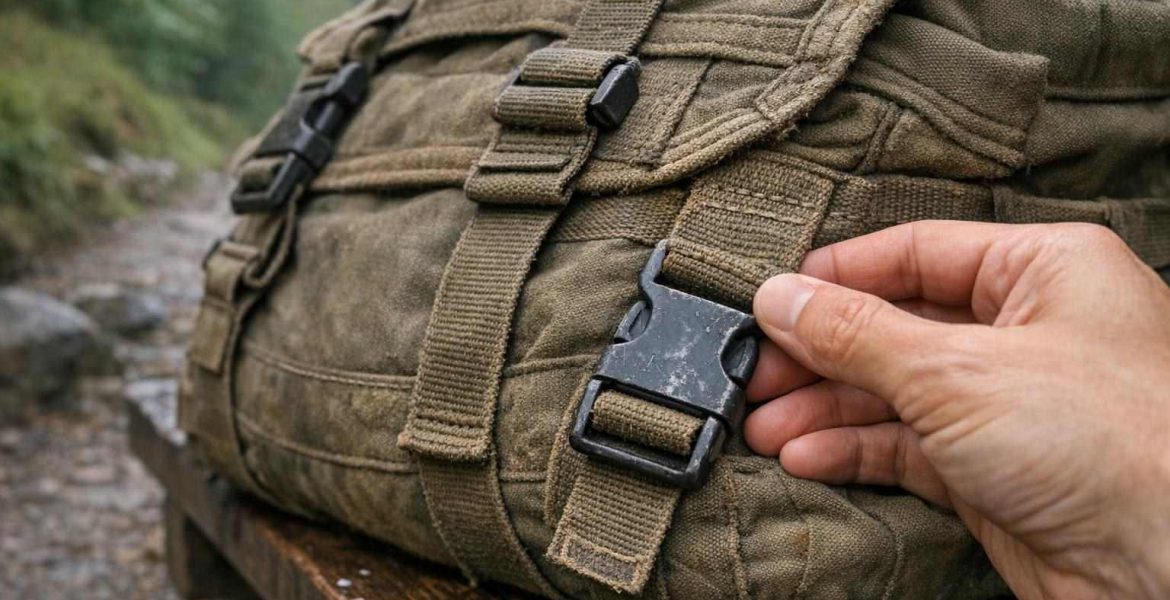
Recognizing Wear on Surplus Pack Straps Before a Long Walk
On October 24, 2026 by Christopher HaskinsBe aware that a lot of surplus rucksack gear looks OK on the shop shelf, yet has flaws in important places that can only be revealed when the pack is flexed, e.g. folded straps springing back into place, dirty buckles etc. So carry out some tests, go through all the wear points, move against clothing, go through repeated adjustments, and then decide whether to use it as is, to repair small flaws, or to go for better long-distance walking gear. The newest looking pack is not necessarily the best for very long-distance walking – its history has to match up with the planned distance, weight, and failure consequences.
Start with the load-bearing webbing
Start by checking the load-bearing webbing of the shoulder straps, hip belt, sternum strap (if equipped) and the pack body to which they are attached. These sections will bear the greatest amount of wear and should be checked more thoroughly than the loose compression straps.
Check for signs of wear, such as thinning, fraying, fuzzing, horizontal creasing, cuts and melt spots. Surface fibers can start to separate from the main fibers while still feeling strong. Some color change is not always a sign of failure but discolored areas that are also hard, cracked or have a melt spot are a cause for concern.
Look closely at the stitching at the points where the load-bearing webbing is attached to the pack. All the thread must be present and pulled tight. Look for long pulled loops of thread or for where the fabric has begun to pull away from the stitches. Old repairs can be bad news, but provided they are relatively smooth and do not have hard edges, they should be OK.
The particular parts of the pack where the straps join to each other should also be inspected. In particular, look at the thread used to sew the attachment, to see if it is still there and pulled tight. If the strap passes through a buckle or slider, pull it slowly through by hand to check for any signs of wear or damage such as threads pulling out of holes, worn polished places on the inside of the buckle, or torn threads from the hole. Cracked or bent plastic or metal parts that create sharp points also suggest the need for more investigation or even to look elsewhere for another similar pack.
Read wear patterns, not just visible damage
Wear can tell you lots about how a pack has been used, and where problems are likely to develop. A smooth, polished patch of webbing may indicate that a slider has been worn through repeatedly. Fraying near to the buckle of a worn pack may indicate constant adjustment of the strap, and wearing of the lower edge of a shoulder-strap can indicate rubbing against the back of the pack, or your clothing.
Minor damage has to be looked at in perspective, and a short cut across a piece of webbing for example is a lot worse than surface fuzzing, especially if the cut has reached the stitching or the attachment point. A strap that has been stretched unevenly is also likely to have been subjected to prolonged loading even though there may be no visible damage.
Unless the pack is older (military surplus etc), grime is part of its history, so do try to clean it up as much as possible. However, be aware that old sweat etc can hide cracks in the fabric. Inspect the reverse of each strap and the area where the strap attaches to the pack. Examination of the back of a strap will also reveal any wear to the padding.
Treat a cluster of small wearings as a bigger problem. For example faded webbing, loose stitching, a sticky buckle and worn padding all may be repaired as individual problems but together they indicate that the part of the rucksack in question has been subjected to a lot of wear and possibly might be better to use another rucksack for long distance walks.
Choose between repair, replacement, and another pack
However, the degree to which you should repair versus replace an item will depend on several factors, including the severity of the damage, the location of the damage, and your level of confidence in your repair abilities. For example, fuzzing of a non-load bearing compression strap would likely be trimmed and watched for further deterioration. However, the same amount of damage to a shoulder-strap anchoring point could cause serious problems and be better to simply replace the pack.
A replacement buckle is often readily available for damaged straps, and provides a good solution to the failed hardware, provided the strap and stitching are otherwise sound. Re-stitching is also a possibility if you have the correct thread and are able to stitch it up securely – note that simple running stitch through decoritative pattern is NOT sufficient to repair load-bearing parts of the pack, and should be tested before use.
However, sometimes the simplest option is to buy another pack. If the webbing in several places is brittle, the attachment seams are starting to pull apart, the frame or harness is damaged or breaking in half, then it is not worth spending a lot of money or time repairing a pack that will not last for much longer. Much surplus equipment is good value for money but that does not mean to make bad choices because of low purchase price.
Also, remember to test the pack with the same amount and type of weight you plan to carry on your trip, not a lot of heavy gear for a short, easy day hike. The same pack that easily handles a day's worth of light snacks and lotion for a short, easy day hike could fail on a longer, more demanding trip with more food and gear.
Test fit and movement before departure
Test a loaded pack and then test the adjustment of the straps. Also test the pack as you would wear it while going up and down stairs, bending over and around corners, and going up steep inclines.
Make sure to test a pack by repeatedly tightening and loosening all of the straps – including the shoulder straps, hip belt, and sternum strap. It is surprising how often a slider will hold the first time it is used, only to creep on subsequent uses – especially if the webbing has been wet, twisted or subjected to unusual angles of pull. Soon after any test walk, go back and inspect all of the previous test areas for signs of fresh wear.
Remember to test for function not just comfort. Even though a strap may be covered in a layer of padding it does not mean the anchor point is okay. Test all areas of the pack before you set off.
Keep maintenance simple and repeatable
Ensure cleaning of straps is done gently enough to not layer a polish or dressing, including oil, onto the fibers of the straps. Allow any dampened components to dry before storage of the pack. Folding straps sharply to keep in pack may cause scratches to fibers of straps over long periods of time. Never use heat to dry synthetic fibers, and don't use chemicals to soften hardened sections of straps.
Recording your findings is essential before storing your backpack. Take a moment to make a note of any loose threads, stiff buckles or of repair work carried out to seams. This will provide a prompt when the time comes for your next inspection and will help to ensure that any minor problems are not overlooked and end up becoming serious failures when the time comes for a big walk.
Most important, for military surplus packs, exercise sound judgment in assessing load-bearing parts. Compare the condition of a pack with the demands of the proposed trip and abandon it should it prove inferior. Protect your back, but don't lose a treasure to overly scrupulous application.